#Digital

25/01/2023



Collaborative online work environments or virtual workspaces, commonly referred to as Digital Workspaces, are becoming increasingly popular among businesses.
In Europe, more than 51% of organizations are equipped with them, according to an article published in 2023 by the specialist media outlet Archimag.
The reason for this trend is simple: these platforms make everyday life easier for increasingly mobile employees, whether they are in the office, working remotely, or spread across multiple sites.
Thanks to the digital workspace, they benefit from a comprehensive, controlled, collaborative, and easy-to-use working environment.
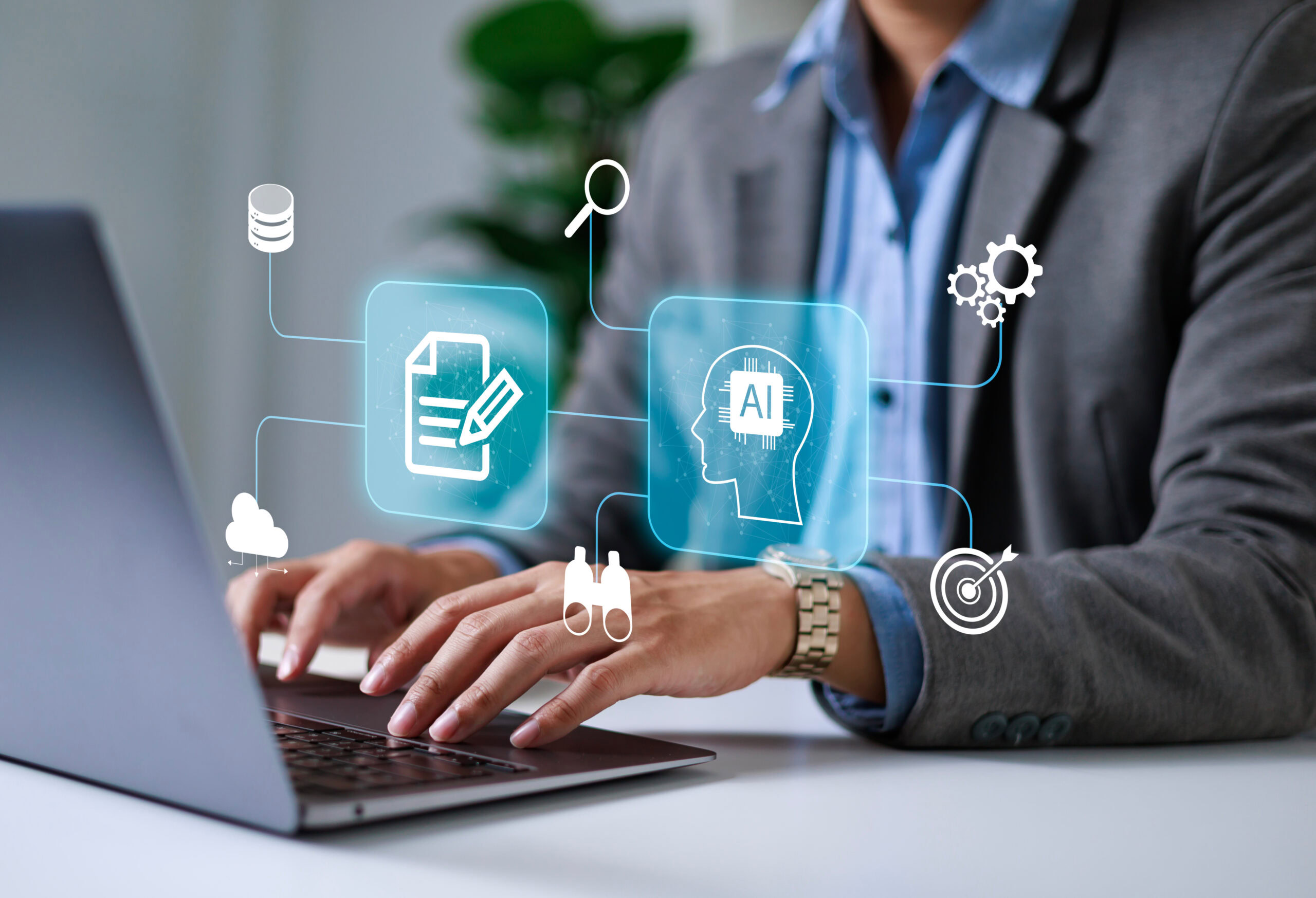
To increase user productivity, artificial intelligence features are emerging in applications, despite the fact that the actual adoption of AI by companies is still in its infancy.
How do collaborative work platforms integrate AI uses in the enterprise? What is the “augmented” digital workspace? What are the benefits and risks to consider?
Our experts explain how the digital workspace can increase your employees’ productivity through AI.
The rise in bandwidth capacity has enabled a gradual opening up of companies’ digital tools to the outside world.
Whereas in the past, employees had to go to their company’s offices to access their business software, it is now possible to work collaboratively and simultaneously on the same document from anywhere in the world.
Hosted in the cloud, the workspace has the advantage of being accessible from any device: workstation, laptop, smartphone, or tablet.
Far from being simple office software, the digital workspace is a platform, an ecosystem that centralizes the digital tools used on a daily basis: office suites (word processing, spreadsheets, slides, and presentations), tools for organizing tasks and projects (calendars, schedules, etc.), communication (messaging, chat, videoconferencing), as well as a space for storing and collaboratively managing documents.
At the heart of the company, it connects to business software (CRM, ERP) to facilitate information sharing and provide a consistent user experience. Thanks to this integration, collaborative platforms are driving the digital transformation of businesses.
In 2025, the digital workspace continues to evolve. It adapts to new uses and offers “augmented” workspaces, particularly thanks to the gradual integration of AI agents.
Need advice ?
An updated version of digital workspaces, the augmented digital workspace reduces employee production time.
Automation of repetitive tasks: AI synthesizes a set of data sources, produces initial content drafts, and even processes emails, freeing up time for higher value-added tasks.
Simplified collaboration: automatic summaries, meeting summaries, and action suggestions facilitate project tracking and strengthen teamwork continuity.
Simplified user experience: thanks to contextual help, recommendations, and faster access to information, employees can navigate their tools more easily.
As a result, users change their approach and gradually become AI supervisors: they no longer perform all tasks themselves, but guide, control, and adjust the suggestions generated by the agents integrated into their tools.
By integrating AI, the augmented digital workspace aims to speed up and simplify the completion of tasks, especially the most repetitive and time-consuming ones.
Microsoft Copilot, Google Gemini, and ChatGPT make it easy to integrate AI directly into your everyday tools: your corporate messaging system (Teams, Google Chat), your inbox, or simply your word processing and spreadsheet tools (Word, Google Docs, Excel, Google Sheets).
In business, AI assistants are already improving productivity through concrete use cases.
The deployment of AI, even through collaborative platforms from reliable and recognized publishers, must be controlled in order to ensure practices that are consistent with your cybersecurity and data protection requirements.
Let’s discuss your AI needs now !
The integration of artificial intelligence into digital workspace tools must not come at the expense of cybersecurity. The AI Act, which came into force last year, echoes recurring concerns about the digital sovereignty of states and companies.
Yes, the use of AI can be made completely secure in companies. But data confidentiality must be considered before deploying it across your organization.
Understand that access to AI tools is governed by roles and rights, configured by default for each user. If these rights are too permissive, an employee could access information that does not concern them: pay slips, contracts, contact lists, or commercial data.
It is therefore important to follow the principle of least privilege: ensure that users only access the data they really need and restrict their rights. Tools are available to enhance the confidentiality of the information processed by your employees.
When deploying your collaborative workspaces, Rcarré helps you classify your confidential data. Labeled manually or automatically, under the supervision of our teams, this classification allows you to sort and protect your files according to the level of confidentiality defined by your organization (e.g., public, restricted, confidential).
Depending on the tag applied, the document may be encrypted, restricted to certain users only, watermarked, or subject to limitations (read-only, limited sharing, blocked downloading, etc.).
These security measures built into the platforms can be reinforced. At Rcarré, our experts recommend supervising your employees’ use of AI by deploying a few tools:
DLP (Data Loss Prevention) detects and blocks the sharing of confidential information with AI, for example when writing a prompt for generative AI (LLM such as ChatGPT or Gemini).
CASBs (Cloud Access Security Brokers) sit between users and cloud applications (Microsoft 365, Google Workspace, Salesforce, etc.) to control access and ensure that actions performed in these services comply with the security rules and rights defined by the company.
Finally, implementing a DNS filtering system allows you to control and limit access to certain artificial intelligence services and tools that are not authorized by your company.
With nearly 25 years of experience as an IT service provider, Rcarré has mastered all the technologies integrated into augmented digital workspaces: we offer collaboration, unified communications, and public and private cloud hosting solutions.
Every day, our teams ensure the cybersecurity and maintenance of the IT infrastructure of hundreds of customers in France, Belgium, and Luxembourg.
Contact our teams today to assess your needs.
#Digital
25/01/2023
#Cybersecurity
#Digital
30/03/2023

#Digital
10/05/2022