
#Digital

29.10.25



Holidays are starting. True disconnection, however, often takes a little longer.
The out-of-office message is activated. The desk is tidy. The suitcases are packed.
Yet once the holidays begin, many people still find themselves checking their emails, looking at Teams notifications, or discreetly keeping an eye on ongoing projects.
Today, technology allows us to work from virtually anywhere. But it has also made the boundary between our professional and personal lives thinner than ever before.
In Luxembourg, the right to disconnect is now part of the legal framework, and companies are required to implement appropriate measures to ensure it is respected whenever employees use digital tools as part of their work.
But beyond the legal obligation, one question deserves to be asked:
Why is it still so difficult to truly disconnect?
Contrary to popular belief, the main obstacle to disconnecting is not the tool itself.
Microsoft Teams, Outlook, smartphones, collaborative workspaces, and other digital platforms have become essential to the way businesses operate. They provide greater flexibility, support hybrid working, and enable teams to collaborate efficiently.
The real issue arises when constant connectivity becomes a habit. When an employee checks messages while on holiday, it is not always because an urgent situation requires it. More often than not, it is simply because they are worried about what awaits them when they return.
Behind every connection during a holiday, there is often a fear of coming back to an overflowing inbox, missing an important decision, losing track of a project, or finding themselves several days behind on their workload.
This fear of returning to work leads many of us to maintain a constant connection to our professional activities, even when we are officially on leave.
The result? We are neither fully on holiday nor truly at work.
And when a period of rest no longer allows us to fully recharge, the benefits of taking time off are significantly reduced.
When we talk about the right to disconnect, we often assume that the pressure comes from outside sources: a manager sending messages late in the evening, a client calling during holidays, or a notification appearing on a smartphone.
The reality is sometimes more subtle. How often do we open our inbox without any specific reason? How often do we check Teams or our work notifications simply because we have a few spare minutes?
Over time, these actions become almost automatic. Much like a smoker lighting a cigarette without even thinking about it, many of us open our inboxes out of habit. Not because an urgent situation requires it, but because our brains have become accustomed to checking, monitoring, and anticipating.
Digital tools have been designed to be accessible everywhere and at any time. As we use them day after day, checking emails can become as natural and automatic as looking at the time or checking the weather.
This is precisely what makes disconnecting so difficult.
Even when a company fully respects the right to disconnect, and even when no colleague contacts an employee during their leave, that employee may still feel the need to check what is happening. Out of curiosity. Out of habit. Or simply for reassurance.
The challenge of disconnecting is therefore not solely a matter of tools or regulations. It is also about learning to resist our digital reflexes and breaking habits that have become deeply ingrained in our daily lives.
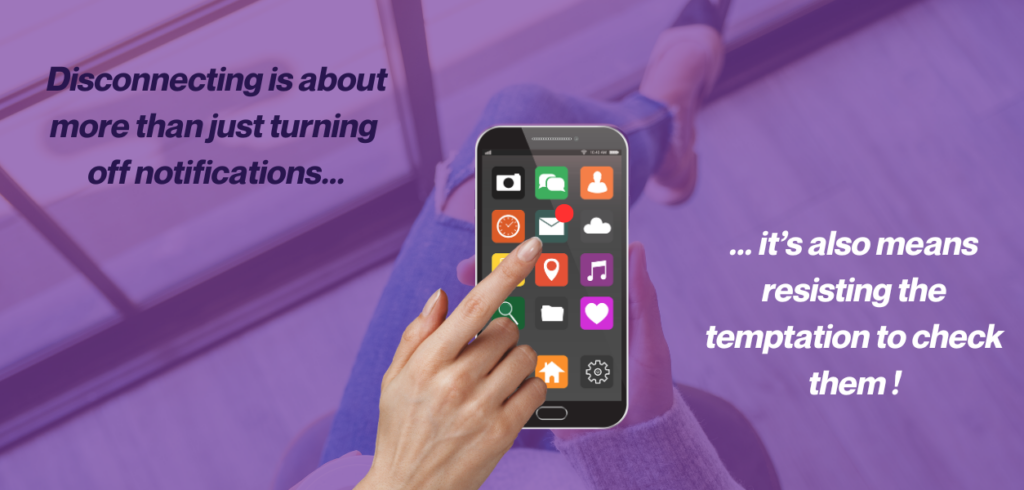
No organization can genuinely claim to promote the right to disconnect if its operations depend entirely on a few key individuals.
In fact, the ability for employees to go on holiday with peace of mind is often an excellent indicator of organizational maturity.
This relies, among other things, on:
When employees know that their team has access to the information and resources needed to move forward without them, it naturally becomes much easier to disconnect.
Digital tools are often blamed for encouraging constant connectivity. Yet, when used properly, they can actually make it easier to disconnect.
Modern collaboration platforms can help organizations:
When a project, process, or client file is properly documented, shared, and accessible to the right people, it becomes much easier for the person responsible to leave for holiday with complete peace of mind.
For a long time, constant availability was seen as a sign of professional commitment. Today, mindsets have evolved.
High-performing organizations understand that recovery is an essential part of sustainable performance. Employees who have had the opportunity to properly rest generally return with more energy, better focus, greater creativity, and stronger decision-making abilities.
Enabling teams to disconnect is therefore not just a matter of well-being. It is also a powerful driver of collective efficiency and long-term performance.
The success of a digital transformation cannot be measured solely by the number of tools that have been deployed. It should also be measured by an organization’s ability to operate effectively when part of its workforce is away.
Ultimately, a truly mature organization is not one where everyone stays connected during their holidays. It is one where everyone can leave with peace of mind, knowing that processes, tools, and teams will continue to function smoothly in their absence.

#Digital
29.10.25
#Digital
09.12.25

#Digital
#Services IT
25.02.25